










The Rocket Appartamento is an entry-level heat exchanger (HX) espresso machine—the smallest model in Rocket's lineup. We tested it extensively over two years of daily use in our Academy.
The Appartamento retails for around CHF 1,490 in Switzerland, while in Germany and across Europe it sells for approximately €1,200 to €1,300. For a classic heat exchanger without PID temperature control, that places it right in the mid-range price segment.
In 2024, Rocket launched the Appartamento TCA as the successor to the classic Appartamento. We have thoroughly reviewed that model as well.
| Specification | Rocket Appartamento |
|---|---|
| Price | approx. €1,200–€1,300 (EU) / approx. CHF 1,490 (CH) |
| Type | Heat exchanger (HX) with vibration pump, non-PID |
| Group Head | Faema E61 |
| Brew Temperature | 93.7–93.8 °C (fixed, non-adjustable) |
| Water Tank | 2.9 liters, top-fillable, removable |
| Dimensions (W × D × H) | 27.4 × 42.5 × 33.5 cm |
| Weight | 20 kg |
Design & Build Quality: Stylish, but Sharp-Edged
The Rocket Appartamento weighs in at 20 kilograms and measures 27.4 cm in width, 42.5 cm in depth, and 33.5 cm in height. As with almost all machines featuring an E61 group head, the footprint is quite deep—so make sure you measure your countertop space beforehand.
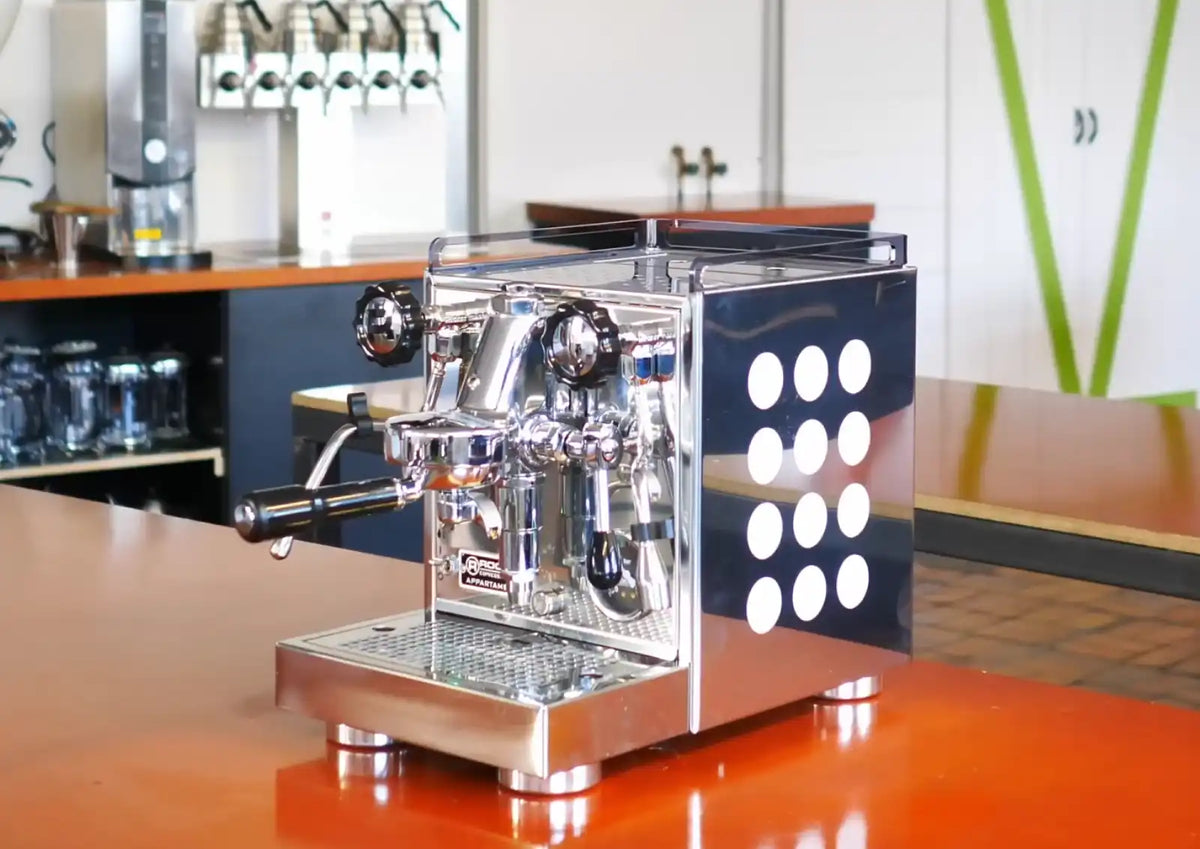
In terms of design, Rocket is one of the market leaders. The pressure gauge with its small display window is a genuine eye-catcher, and the circular side-panel cutouts set a stylish accent. The stainless steel housing makes a great visual impression.
However: The fit and finish has its flaws. Sharp, un-deburred metal edges are present throughout the machine. Around the drip tray, the body panel folds, and the cup grate—Italian manufacturers simply seem unable to break sharp edges. While this isn't unique to Rocket (ECM suffers from the exact same issue), in this price bracket, it is frustrating. It isn't dangerous, but it feels unpleasant when handling the machine.
Another point of criticism: The cup rail on top comes standard as a cheap plastic frame that breaks very easily. We tested both the white and copper side-dot editions—and both times the plastic rail felt flimsy. The premium stainless steel cup rail must be purchased separately as an accessory (CHF 99 in Switzerland). On a 1,500-franc machine, that should really be included out of the box. On the newer black edition, it is finally included—though that version carries a higher price tag.
On the positive side: The 2.9-liter water reservoir fills easily from the top and removes completely without hassle. No loose silicone hoses to thread around—a huge advantage when placing the machine beneath wall cabinets.
Temperature Management: Textbook Flatline
Thermal stability is where the Appartamento excels completely. Testing with our Scace thermofilter, we logged a rock-solid 93.7 to 93.8 °C throughout the entire extraction duration. No thermal dips, no spikes—a textbook flatline curve.
The catch: You cannot adjust this temperature. There is no PID control. The 93.8 °C target is fixed. In theory, a technician could lower the boiler pressure manually via the internal pressostat, but you shouldn't attempt that yourself—especially since it would reduce steam power as well.
For 95% of coffee roasts, 93.5 to 94 °C is a sweet spot. Only for ultra-dark roasts might you wish for a cooler profile. For everything else: target temperature is spot-on, and thermal consistency is outstanding. End of story.
Espresso Quality: The E61 Group Delivers
The Appartamento uses the classic Faema E61 group head—the same mechanical foundation used across dozens of espresso machines. Rocket sources the group head directly from Faema and builds their chassis around it. Shot-to-shot thermal performance depends entirely on boiler design and thermo-siphon tuning.
Rocket got both right on this machine. Extractions are clean, yielding well-balanced espresso shots with rich body and sweet flavor notes. Testing a blend made of equal parts Robusta, Nicaragua, and Brazil Arabicas, the flavor profiles came through crisp—bold yet harmonious.
The E61 group head simply works. If you prepare your espresso correctly—with proper puck prep, level tamping, and a dialed-in grind—the machine delivers consistently great shots. It is reliable enough that any extraction errors are almost certainly barista error, not machine inconsistency.
Milk Frothing & Steam: Raw Power
For a compact heat exchanger, steam power is impressive. Milk rolls effortlessly in the pitcher—you barely need to move it around. The vortex phase kicks in almost automatically, producing silky, micro-foamed milk for latte art.
The boiler temperature is deliberately tuned to the upper boundary, which benefits steam power. On a heat exchanger without independent PID boiler control, this represents a smart compromise: you get abundant steam power without overheating the brew circuit.
The only caveat: if you plan to brew ultra-dark Italian roasts, 94 °C might theoretically feel slightly too warm. But for 95% of use cases, this factory setting works brilliantly.
Workflow & Daily Usability: Good Ideas, Annoying Details
Daily operation is blissfully simple: turn on, let warm up, pull a shot. No complex digital menus, no PID parameters to tweak. That makes it very beginner-friendly.
However: The group head positioning relative to the short drip tray is annoying. The portafilter locks in very far forward. To ensure espresso drips into cups sitting squarely on the drip grate, Rocket angled the portafilter spouts backward toward the machine. While clever, this makes tamping awkward: you can no longer rest the portafilter flat on a tamping mat by its spouts without it tilting.
Furthermore: The drip tray isn't deep enough. There is empty space beneath it inside the chassis that could have been utilized for a deeper tray. Because the group head extends so far forward, flushing the group between shots frequently splashes water over the front edge of the tray. That gets frustrating during daily use.
The portafilter spouts really ought to point the other way. It's hard to understand why it was engineered like this. Making the machine a couple of centimeters deeper would have drastically improved workflow.
On the positive side: The water tank design is fantastic. Flip the lid, lift the tank out, refill or clean, and drop it back in. No hoses, no fuss.
Noise Level & Maintenance
The vibration pump is audible, but not annoyingly loud. Compared to the Quick Mill Rubino, we measured a minor 1 to 2 decibel difference—essentially identical.
Regarding maintenance: Should you ever need to disassemble the machine for repairs, be prepared. It is doable, but internal component layout is cramped. Replacing a solenoid valve took us an hour and a half. That is tedious. In comparison: an ECM machine is similarly compact, but slightly better laid out for servicing.
The boiler is uninsulated, which is a disadvantage compared to machines like the Quick Mill Rubino. This translates to higher standby power draw, though we did not run dedicated power consumption logging on this model.
Machines like this last for decades—if you use clean, properly softened water. Limescale is the primary killer of home espresso machines, regardless of price category. Use filtered water, backflush regularly with blind filter powder, and this machine will easily outlast a decade. By comparison: a consumer appliance like the Sage Barista Pro suffered a component failure after six months in our lab—something that rarely happens on a heavy-duty E61 machine like the Rocket.
Price-Performance Ratio: Upper Mid-Range, but Lacks PID
CHF 1,490 (or €1,200 to €1,300 in the EU) for a non-PID heat exchanger with a vibration pump sits in the upper mid-range price segment. There are competing machines offering similar features for less money. However: The Rocket wins points on iconic design, rock-solid brew temperature consistency, and steam performance.
For that kind of money, we expect top-tier performance—and on temperature stability and shot quality, the Appartamento delivers. Where it loses marks is on workflow details (plastic cup rail, sharp edges, narrow drip tray).
If you are willing to spend an extra 200 to 300 francs, other brands offer heat exchangers equipped with PID temperature control, giving you extra flexibility. But at 93.5 to 94 °C, you can extract almost any coffee roast exceptionally well anyway. A PID is nice to have, but by no means mandatory.
Verdict: A Solid Machine with Annoying Workflow Details
The Rocket Appartamento is a machine for home baristas who take espresso seriously. Its strengths: rock-solid thermal stability, outstanding steam power, iconic design, and long-term durability. Its weaknesses: group head positioning too far forward, shallow drip tray, sharp panel edges, and a plastic cup rail that must be upgraded.
Who is it for? Home baristas looking for a straightforward heat exchanger machine who don't need PID temperature tweaking. If you're happy brewing at a fixed 93.8 °C (which covers 95% of roasts), you get a heavy-duty machine that just keeps running.
Who is it NOT for? Anyone who brews exclusively ultra-dark roasts or wants to experiment with temperature profiling. And anyone bothered by minor workflow flaws.
An added bonus: Rocket has a very active global community. If you ever have questions or need maintenance tips, user forums offer plenty of helpful advice.
Would we buy it? If it fits your budget and you can live with the minor usability quirks: Yes. But we would immediately order the CHF 99 stainless steel cup rail. The stock plastic piece isn't worth keeping.
One final note: On manual E61 machines like this, barista technique makes all the difference. You must understand espresso fundamentals—grind size, dose weight, level tamping, and puck prep. The machine supplies rock-solid consistency; the rest is up to your technique. Master that, and this Appartamento will pull exceptionally good espresso.


